
The Difference Between a Toxic Environment and a Bad Day
And Why Sensitive People Can't Afford to Confuse the Two
You walk out of a meeting and something feels off.
You can’t name it yet. Just a tightness in your chest. A replay starting in your head before you’ve even reached your desk.
You ask yourself the question every sensitive person asks eventually.
Was that just a bad day. Or is something actually wrong here.
This question matters more than it sounds like it does.
Get the answer wrong one way, and you’ll leave a good situation over a rough patch. Get it wrong the other way, and you’ll stay in a bad one for years, quietly telling yourself it’s fine.
You need to learn the difference. Nobody teaches you this. So you learn it the hard way, usually more than once.
Here’s what you eventually figure out.
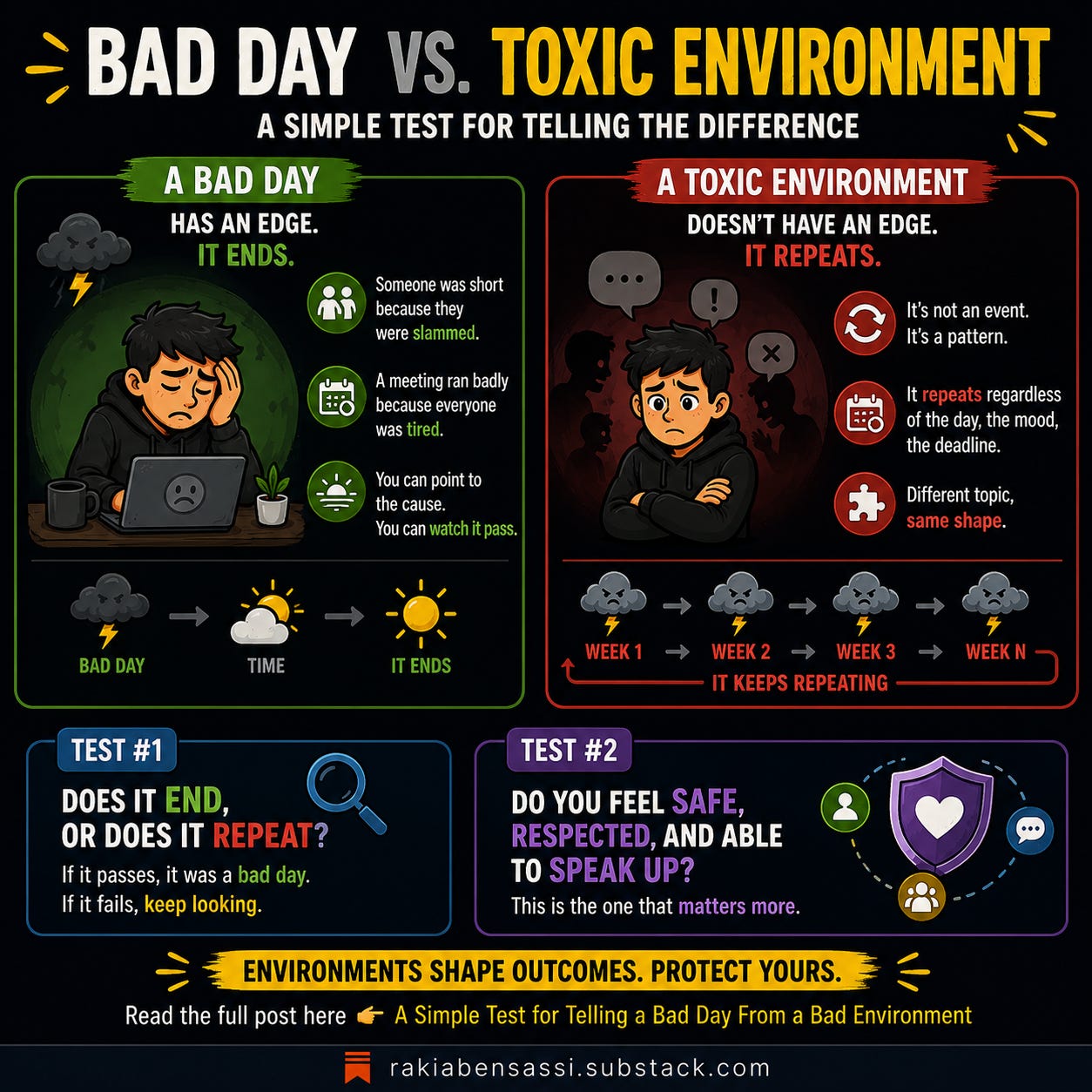
A bad day has an edge to it. It ends. Someone was short with you because they were slammed. A meeting ran badly because everyone was tired. You can point to the cause. You can watch it pass.
A toxic environment doesn’t have an edge. It’s not an event. It’s a pattern. It repeats regardless of the day, the mood, the deadline. The thing that felt off in that meeting happens again next week. And the week after. Different topic, same shape.
That’s the first test. Does it end, or does it repeat.
Here’s the second test, and it’s the one that matters more.
In a bad day, you can say what’s on your mind. You might get pushback. You might be wrong. But saying it doesn’t cost you anything beyond being wrong in the moment.
In a toxic environment, you stop saying things. Not because you decide to. Because you notice, gradually, that saying them doesn’t go anywhere good. So you edit before you speak. You test the water with something small and safe. You watch what happens to the last person who spoke up.
This is the part that’s hard to see from inside it, because it doesn’t feel like a decision. It feels like exhaustion. It feels like you’ve just gotten quieter lately. You tell yourself you’re being more strategic. More mature. Less reactive.
You’re not. You’re adapting to a room that punished the version of you that used to speak.
The Distinction Matters
Here’s why this distinction matters so much if you’re a sensitive person specifically.
You feel things other people don’t notice. The tone that shifted half a second too long. The question that sounded like curiosity but functioned like a door closing. The tension nobody named out loud but everyone in the room absorbed anyway.
Most people miss these signals entirely. You don’t get that option. They land whether you want them to or not.
This is not a flaw. Researchers have studied this for decades. Something like fifteen to twenty percent of people process stimuli more deeply than average. Noticing more. Feeling more. Being shaped more by both good and bad environments.
In a healthy room, this is a superpower. You catch problems before they become expensive. You read a client’s hesitation before they voice it. You know when a teammate is quietly burning out weeks before they say anything.
In a toxic room, the exact same trait becomes a liability. You absorb more of what’s wrong. You carry more of the tension home. The thing that makes you excellent in one context makes you exhausted in another.
The Cruel Trap
So here’s the trap, and it’s a cruel one.
