Let me ask you a quick question. Which technology is emerging as the essential cure for AI amnesia (forgetfulness)?
A) Building larger neural networks with trillions more parameters.
B) The humble database, acting as an external brain or memory layer.
C) A new class of “Agentic Systems” that nobody truly understands yet.
D) Extremely sophisticated prompt engineering that tricks the AI into remembering.
Think about your answer. Lock it in. We’re going to come back to this at the end.
Let’s be honest, you’ve probably had a conversation with an AI and felt like you were talking to a goldfish. You have to repeat yourself constantly, and it forgets the context of your conversation the moment you start a new one. Frustrating, right?
But what if I told you that this is all changing, and the solution is far more elegant than just throwing more processing power at the problem?
The future of AI that can remember, learn, and truly collaborate with us is here, and it all comes down to memory. Not just one type of memory, but a whole hierarchy of interconnected memory systems, just like our own brains.
You see, for an AI to be truly useful, it needs to have a memory that’s as sophisticated as its intelligence. It needs to remember who you are, what you’ve talked about before, and what your goals are. It needs to learn from its experiences and get smarter over time.
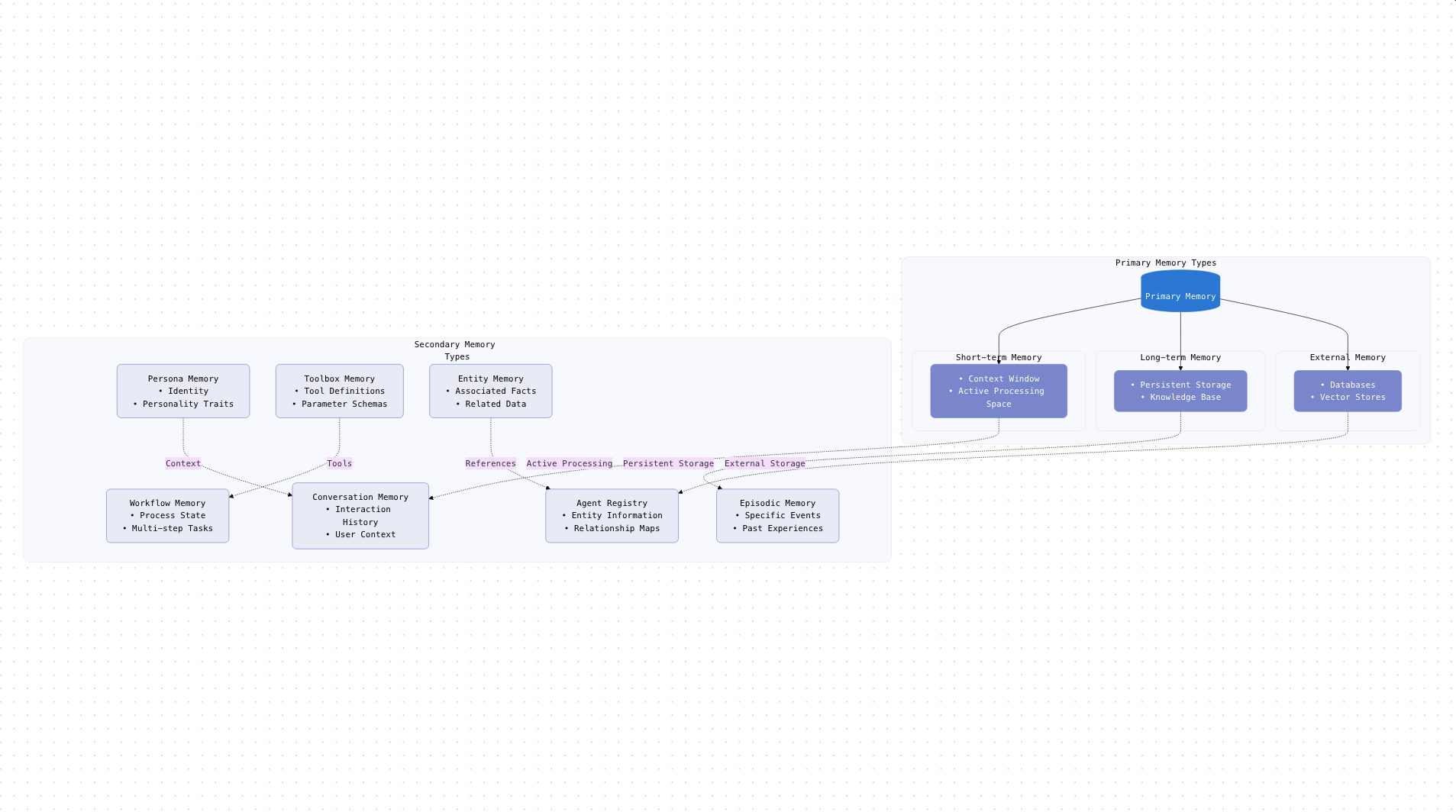
The key to unlocking this potential lies in a multi-layered approach to AI memory, as you can see in the diagram. Let’s break it down.
Primary Memory: The AI’s Working Brain
Think of Primary Memory as the AI’s conscious mind, the stuff it’s thinking about right now. It’s divided into three key areas:
Short-Term Memory: This is the AI’s “context window,” its immediate recall of the current conversation. It’s what allows the AI to follow the thread of a conversation and respond coherently. But this memory is fleeting, like a scribble on a whiteboard that gets erased after each conversation.
Long-Term Memory: This is where things get interesting. This is the AI’s persistent storage, its knowledge base. It’s where the AI stores information that it needs to remember across conversations. This is where the AI starts to feel less like a goldfish and more like a partner.
External Memory: Now, this is the game-changer. External Memory is where the AI can connect to databases and vector stores, giving it access to vast amounts of information beyond its initial training. This is the AI’s “external brain,” and it’s the key to curing AI amnesia.
Secondary Memory: The AI’s Soul
If Primary Memory is the AI’s brain, then Secondary Memory is its soul. This is where the AI develops its personality, its skills, and its understanding of the world. It’s where the AI becomes more than just a tool and starts to feel like a true collaborator. Here’s a peek into the different types of Secondary Memory:
Persona Memory: This is what gives the AI its identity and personality. It’s the difference between a generic chatbot and an AI that feels like a real person.
Toolbox Memory: This is the AI’s skillset. It’s where the AI stores its knowledge of different tools and how to use them.
Entity Memory: This is the AI’s understanding of the world. It’s where the AI stores facts and information about people, places, and things.
Workflow Memory: This is the AI’s ability to handle multi-step tasks and complex projects. It’s what allows the AI to break down a big goal into smaller, manageable steps.
Conversation Memory: This is the AI’s memory of past conversations. It’s what allows the AI to remember what you’ve talked about before and pick up where you left off.
Agent Registry: This is where the AI keeps track of other AIs and their capabilities. It’s the foundation for multi-agent systems where AIs can collaborate to solve complex problems.
Episodic Memory: This is the AI’s memory of specific events and past experiences. It’s what allows the AI to learn from its mistakes and get better over time.
And that brings us right back to the question from the beginning. Which technology is emerging as the essential cure for AI amnesia?
The correct answer is B. Databases — specifically the Vector Databases that power Retrieval-Augmented Generation (RAG) — are the foundational technology giving AI a persistent, long-term memory.
They allow the AI to look beyond its initial training and immediate conversation, effectively creating the “external brain” needed for true memory and forming the backbone for the next generation of powerful AI Agents.
Until next time—stay curious and keep learning!
Cheers,
Rakia
🎁 I deliver bespoke tech workshops and seminars that:
✨ Make complex topics exciting
✨ Show real-world case studies
✨ Give hands-on with tailored content
✨ Let you leave energized 🚀 not overwhelmed!
Want this energy for yourself or YOUR team? 👉 Reach out or DM me.
Further Reading and Viewing
🎁 Special Gift for You
I’ve got a couple of great offers to help you go even deeper. FREE access to my video courses - available for a limited time, so don’t wait too long!
🔥 Modern Software Engineering: Architecture, Cloud & Security
FREE coupon RAKIA_SOFT_ENG_5🤖 The AI for Software Engineering Bootcamp 2025
FREE coupon AI_ASSISTED_ENG_4🔐 Secure Software Development: Principles, Design, and Gen-AI
FREE coupon RAKIA_SECURE_APPS_4FREE coupon RAKIA_API_DESIGN_4
🐳 Getting Started with Docker & Kubernetes + Hands-On
FREE coupon RAKIA_DOCKER_K8S_4⚡ Master Web Performance: From Novice to Expert
FREE coupon RAKIA_WEB_PERF_4
Want more?
💡 🧠 I share content about engineering, technology, and leadership for a community of smart, curious people. For more insights and tech updates, join my newsletter and subscribe to my YouTube channel.